Sovereignty, resilience and openness will decide who leads the next decade of satellite communications
By Brian Jakins, SVP Global Sales & Market Development, ST Engineering iDirect
In the past few weeks, I have sat with multiple customers across Asia, LATAM and the Middle East who all have different missions and different budgets, but the same question: “With all this capacity in the sky, why is it still so hard to get what we need?”
That question captures where our industry stands in 2026.
We have never had more. Mega-constellations are launching at a pace few predicted a decade ago. Europe’s IRIS² has moved into production. Amazon Leo is scaling up. According to the GSMA, more than 120 mobile operators are now partnering with satellite players, and dozens already have live satellite services. GEO, MEO and LEO capacity is more abundant than at any point in our history.
Customers are not asking for more connectivity. But they are asking for less complexity.
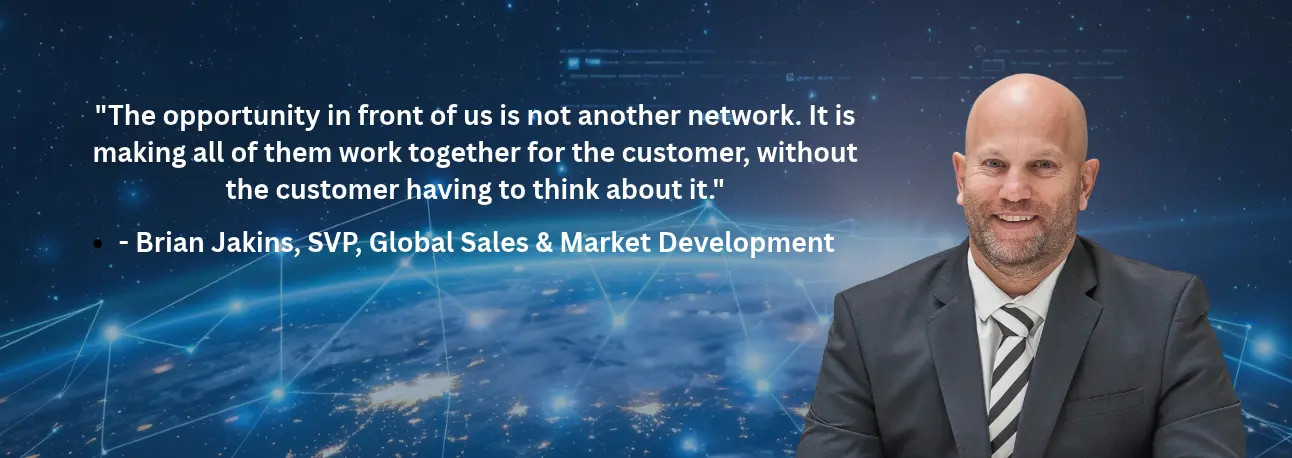
The opportunity in front of us is not another network. It is making all of them work together for the customer, without the customer having to think about it. Four shifts make that urgent.
1. Sovereignty has moved from the defence ministry to the cabinet table
For years, sovereignty was a defence conversation. Not anymore. Geopolitics has pushed every government to ask a harder question about the infrastructure its economy, energy, transport and public services run on: who controls it when it matters most?
As Viasat’s Mark Dankberg put it at SatShow this year, a company in space can now deliver connectivity into your country “whether you want it or not.” That reality is reshaping procurement from Brussels to Riyadh to Jakarta.
But sovereignty done badly becomes isolation, and isolation becomes obsolescence. Nations still want global innovation, multiple suppliers and the freedom to adopt new capability as it arrives. The winning model is control without lock-in — sovereign operations, data governance and security, built on open, multi-vendor foundations.
Sovereignty should not limit choice or the flexibility to leverage innovation.
2. Multi-orbit is a resilience strategy, not an architecture diagram
The “which orbit wins” debate is over. The answer is all of them and, for resilience, none of them alone. LEO brings latency, GEO brings efficient wide-area reach, MEO sits powerfully in between. No customer wants all their eggs in one basket.
The value isn’t having access to several networks. It is orchestrating them intelligently and in real time, matching each application to the right resource, based on available capacity, and all occurring so seamlessly that the end user never notices a decision was made.
That is what customers mean by resilience. Not a backup link. Continuity.
3. Satellite is becoming part of the mobile network
Direct-to-device and 5G non-terrestrial networks are the biggest change to our addressable market in a generation. For the first time, satellite is becoming part of the mobile network rather than an alternative to it.
That convergence raises the bar. Satellite must speak the operator’s language: standards-based, cloud-native, integrated with the mobile core and able to roam across networks and orbits. The revenue will take time to prove, and we should be honest about that. But the direction is set, and the companies that bridge telco and satcom will shape what comes next.
4. Automation must earn trust
More orbits, more networks and more partners mean more decisions than any operations team can make by hand. AI and automation are essential: faster provisioning, earlier detection of problems, smarter use of capacity.
But we cannot automate away accountability. In government and critical infrastructure especially, operators must understand the decisions being made, set the policies that guide them and retain oversight. Automation and governance must advance together.
The goal isn’t automation for its own sake. It is better outcomes and freeing people to apply judgement where it matters most.
The real choice: walled gardens or open ecosystems
Our industry is dividing into two models. Vertically integrated players own everything from the rocket to the terminal, and they have set a pace the rest of us must respect. The alternative is an open ecosystem: interoperable networks, standards-based interfaces, multi-vendor choice and seamless roaming across operators and orbits.
I believe the open model wins where it matters most for governments that cannot accept dependence on a single provider, for operators protecting investments while modernising at their own pace, and for customers who don’t want to swap one form of lock-in for another.
But only if we actually deliver it. That means partnering more, standardising faster, and moving at a pace closer to software than to the five-to-seven-year cycles our industry is used to.
Where this takes us
Satellite is no longer a niche. Governments depend on it. Mobile operators are building it into their networks. Ships, aircraft, energy assets and remote communities rely on it every day.
The future is multi-orbit, multi-vendor and increasingly woven into terrestrial networks. The companies that thrive won’t be the ones with the most satellites. They will be the ones that make every connection work together securely, resiliently and simply.
After more than two decades in this industry, I have never seen a bigger opportunity. Our job is to turn the complexity we have created into the one thing customers have always wanted: connectivity they can trust and never have to think about.
What are you hearing from your customers? Is the market moving towards open ecosystems, or towards walled gardens?