
By Rami Moussawi, Senior Product Manager
The way people watch video has changed more in the last five years than in the previous twenty and the pace is not slowing. For broadcasters, satellite operators, and content service providers, the question is no longer whether delivery is becoming IP-centric. It already has. The question is how to evolve a proven, reliable infrastructure to meet that future without throwing away what already works.
This is a blog about that evolution: where the market is heading, why satellite remains central to it, and how broadcasters running today’s distribution equipment can modernize their setup more efficiently, more cost-effectively, and with a meaningfully smaller carbon footprint rather than rebuild it from scratch.
The market is moving toward IP, and the numbers are not subtle
Global over-the-top (OTT) and streaming consumption has evolved from an emerging technology into a widely adopted distribution model at the core of the industry. Depending on how the category is drawn, the global OTT video market is valued at roughly USD 352–384 billion in 2026 (Statista; Mordor Intelligence, 2026), with analysts forecasting continued growth at compound annual rates between 8% and 10% (Statista, 2026–2030; Mordor Intelligence, 2026–2031) through the end of the decade.
What is driving those numbers is a fundamental change in viewer expectations. The viewer now expects to watch what they want (including live content) on every screen they own, wherever they are, at any time of day. The television in the living room, the tablet on a commute, the phone in a stadium: audiences treat these as interchangeable windows onto the same content, and they expect each one to just work.
Two realities sit inside that expectation, and both matter for the satellite community:
Linear is not going away; it is coexisting with IP. In many regions, traditional linear broadcast remains the primary way large audiences receive television, and it will stay that way for years. The industry is not flipping a switch from linear to IP; it is running both at once. The infrastructure underneath must serve the established linear world and the growing IP world simultaneously, without forcing operators to choose between them.
Live content is what viewers increasingly demand and it is the hardest thing to deliver. Audiences want live content more than ever: sports, news, events, … But delivering live video at low latency, to every screen, reliably, is not a given. It is one of the most technically demanding problems in the industry, and it is precisely where reliability and efficiency matter most, and precisely where satellite has always been strongest.
Why satellite still belongs at the center of this future
It is fashionable to frame satellite as legacy infrastructure in an IP world. The operational reality says otherwise.
Satellite remains unmatched for one-to-many distribution at scale. When the same content has to reach thousands or millions of endpoints, head-ends, towers, homes, vessels, vehicles, terrestrial unicast becomes exponentially more expensive as the audience grows. Satellite’s economics do the opposite: the cost of reaching one more receiver is effectively zero. For live linear, national DTH, and large-scale content distribution, nothing else delivers that efficiency.
Satellite also remains the backbone of reach and resilience. It serves the places fiber does not: rural regions, maritime fleets, mobile production in extreme environments and it provides the geographic redundancy that premium live events cannot operate without.
What has changed is that satellite is no longer confined to traditional linear delivery. With the arrival of the DVB-NIP (Native IP) standard, the same satellite link that carries linear DTH today can carry native IP, the foundation for IP content delivery over satellite. That means a broadcaster’s existing satellite infrastructure is not a barrier to an IP future. Properly equipped, it becomes the most efficient way to deliver IP video to many endpoints at once.
ST Engineering iDirect has been part of building exactly that bridge. We were directly involved in the development of the DVB-NIP standard alongside steering members Eutelsat and SES, delivered the world’s first DVB-NIP deployment, providing free-to-air public television access in Peru over satellite and are extending the same technology into new domains, including a maritime crew-welfare streaming proof of concept with a fleet operator and partners.
The installed base already owns a trusted platform
If you are running the M6100 Broadcast Satellite Modulator, you made a sound decision. It has earned its reputation in DTH uplinks, primary distribution to head-ends, and contribution links worldwide, with the input redundancy and short switch-over times that vital broadcast links demand. It does the job it was built to do, and it does it reliably.
The point I want to share with you is to show you how to carry that same reliability forward into a setup built for the next decade, from the same engineering team, in the same factory, at the same price point.
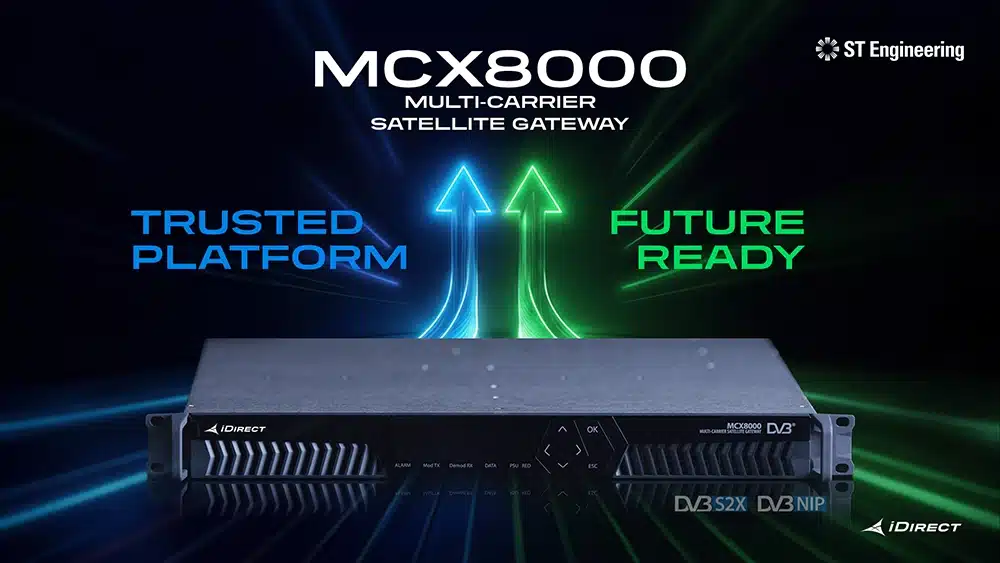
That platform is the MCX8000 Multi-Carrier Satellite Gateway, winner of Product of the Year at NAB and it is best understood not as a replacement to evaluate from scratch, but as the natural next generation of the equipment you already trust.
How the MCX8000 modernizes and future-proofs your setup
The MCX8000 is built on the same M6100 and MCX7000 software heritage, so the capabilities you rely on carry forward. What it adds is density, headroom for IP, and serviceability that changes day-to-day operations.
More capability in far less rack space. The MCX8000 is a slotted, modular 1RU system. In its dual-board configuration, a single chassis delivers up to four DVB-S2X carriers, the equivalent of up to four M6100 units. Configured for 1:1 redundancy, one MCX8000 does the work of two M6100s plus a separate USS0212 redundancy switch, consolidating 3RU of equipment into a single rack unit, with the redundancy switch built in.
A real bridge to IP and OTT. Where the M6100 was designed around traditional transport-stream delivery with MPE IP encapsulation up to 20 Mbps, the MCX8000 supports DVB-NIP with both MPE and GSE-HEM encapsulation at over 300 Mbps per rack unit. That is the headroom required for live video, file delivery, and OTT-style distribution over satellite, the difference between being IP-capable on paper and being IP-ready in practice.
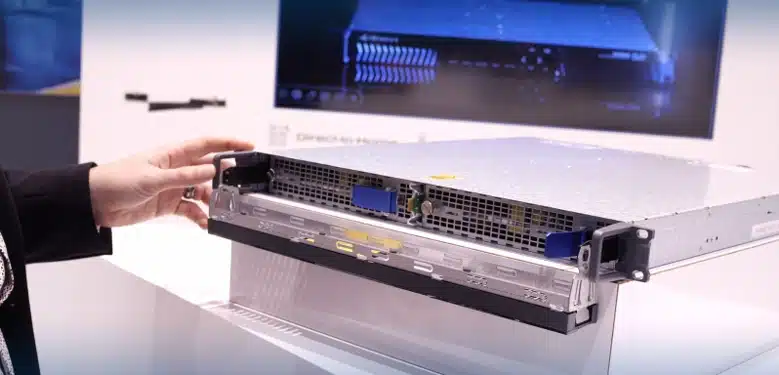
Serviceability that eliminates ship-backs. The MCX8000’s modem boards, power supplies, fans, and platform managers are tool-less and hot-swappable. A module can be added, removed, or upgraded in the field without affecting the other modules in the chassis, no shipping the unit back, no service interruption to the redundant carrier still running alongside it.
Built for premium and live. The MCX8000 carries forward and extends contribution-grade capabilities: SMPTE 2022-7 seamless reconstruction for hitless switching on contribution links, and BISS-CA scrambling for rights-managed sports and premium events.
Efficiency and sustainability are now measurable, not aspirational
For most operations, the strongest argument for modernization is one that shows up on both the power bill and the carbon ledger.
Consolidating equipment into the MCX8000 reduces power draw per stream substantially. In a like-for-like comparison at 100 Mbps per carrier, an MCX8000 configured as two modulators with 1:1 redundancy draws 82W in 1RU, against roughly 110W across 3RU for the equivalent M6100-based setup, about 25% more power-efficient. In a four-modulator configuration, the density gain pushes efficiency to roughly 38% versus the equivalent discrete deployment.
That efficiency compounds across three dimensions of footprint:
- Power. 25–38% less energy per stream directly lowers operating cost and emissions.
- Space. Collapsing 3RU into 1RU reduces rack real estate, cooling load, and the energy that cooling consumes.
- Hardware lifecycle. Field-serviceable, hot-swappable modules mean upgrades and repairs happen by swapping a board rather than replacing or shipping a whole unit, less transport, less e-waste, longer useful life per chassis.
For broadcasters with sustainability commitments, this is the rare upgrade where the operational case and the environmental case point in the same direction.
A legacy in broadcast, and the expertise to carry it forward
The reason this evolution is credible is the same reason the M6100 earned its reputation and trust: it comes from a team that has spent decades in broadcast modulation. ST Engineering iDirect’s heritage in this space runs from the modulators in earth stations and DTH uplinks around the world to active leadership in defining the standards that will shape the next decade, including DVB-NIP. The MCX8000 is the latest expression of long expertise, built by the people who built what came before it.
Map your current setup against a future-ready one
Whether you are running M6100 units, a mix of modulators, or equipment from another vendor entirely, the most useful next step is a concrete one: see exactly what your current stack looks like reimagined on the MCX8000 the rack units saved, the power reduced, the redundancy consolidated, and the IP headroom gained.
Request a configuration assessment. Tell us what you run today, M6100 or non-iDirect modulators, your carrier count, and your redundancy setup and our team will map it to an equivalent MCX8000 configuration, with the density, power, and capability comparison laid out side by side. No assumptions, no rip-and-replace.