By Bert Van der Linden, Director Product Management, ST Engineering iDirect
In my recent conversations with satellite operators, MNOs and service providers, one thing has clearly changed. Nobody is asking whether 5G NR works over satellite anymore. The questions are harder and more useful: where does it create value first, who builds the networks, and how do operators get there without compromising what they already run?

Mobile World Live’s Satellite & NTN Survey Report 2026, published at the end of September, reflects much of what I heard. More than eight in ten respondents say NTN integration matters to their strategic roadmap over the next three to five years, yet only around a quarter are running live services today. To me, that is not a sign of hesitation; it is the profile of a market about to move from trials to deployment. Just as telling, nearly three quarters expect 3GPP common protocols to dominate large-scale commercial deployments by the end of the decade, and respondents name standardization and a strong partner ecosystem as what would most accelerate adoption. I read that as a clear signal that the industry is choosing open, interoperable networks over closed, vertically integrated ones, and that the winners will be those who make satellite a natural extension of the mobile network rather than a separate silo.
At ST Engineering iDirect, we spent the month of September showing what that looks like in practice, with our INT3000 multi-waveform 5G NR NTN user equipment pilot as the centerpiece.
Five takeaways stand out.
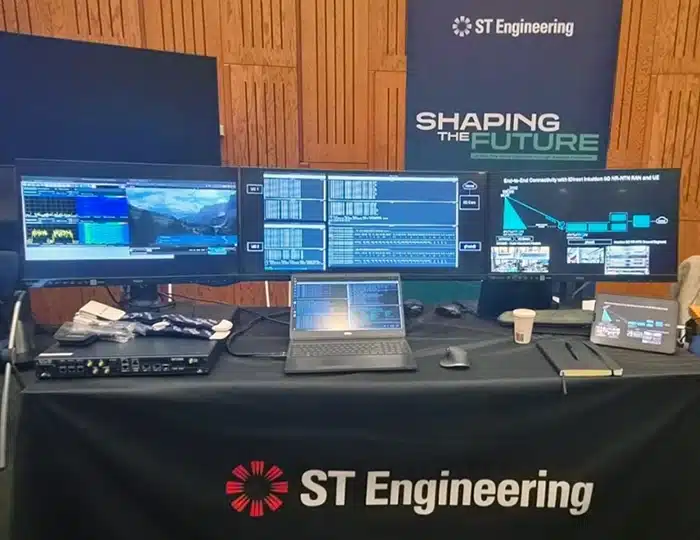
The team showcased the INT3000 multi-waveform 5G NR NTN user equipment at ESA’s ESTEC event in Noordwijk.
1. The terminal is no longer the missing piece
For a long time, the honest answer to “when?” was “when the devices exist.” That is changing. At ST Engineering iDirect, we have demonstrated a pilot of the INT3000, a multi-waveform 5G NR NTN user equipment (UE) modem, working in a full 5G NR NTN network over a satellite simulator. The modem attaches to our Intuition ground system acting as the radio access network, which connects to a 5G Core over standard interfaces, and the user is authorized just as a mobile phone is on a terrestrial network. In the demonstration, two UEs share a cell under simulated GEO conditions, both streaming live HD video, while the gNodeB scheduler allocates bandwidth between them on downlink and uplink.
That last detail matters. One terminal on an empty link proves connectivity. Multiple terminals competing for capacity in a shared cell is what a real network looks like. It builds on our earlier live demonstration of native 5G NR NTN connectivity, with a satellite-optimized gNodeB integrated into Intuition and interfaced with the 5G Core.
For operators: the device side is moving. The open question now is who will build and operate the 5G NR NTN capacity these terminals connect to.
2. Interoperability is the new baseline
The INT3000 is being developed to support 5G NR NTN alongside DVB-S2X and Mx-DMA MRC in one device. A terminal can join a native 5G NR NTN network and still operate in the DVB and hybrid architectures operators will run for years. In a standards-based ecosystem, third-party 5G NR NTN equipment can roam into an iDirect-powered network, and the reverse. Satellite operators become roaming partners for each other and for MNOs as terminals move across terrestrial, 5G NTN and existing satellite networks as one network of networks.
Our advice to our operator customers: start building the partnerships and commercial roaming agreements now. They take longer than the technology.
3. Migration, not replacement
5G NR is today less spectrally efficient than satellite-optimized waveforms such as DVB-S2X and Mx-DMA MRC. For high-throughput, high-reliability services such as cellular backhaul, the industry is not there yet. So, the practical path is coexistence: an operator might keep DVB services over GEO while introducing 5G NTN over a newer NGSO system and move services across as the economics shift. A multi-waveform terminal is what makes that gradual migration possible without swapping out the installed base.
For multi-orbit, the modem is ready; the antenna sets the pace. Different constellations can require different antenna characteristics, down to polarization within the same band, so antenna design will shape the multi-orbit business case as much as the radio standard.
4. Resilience is a design requirement, not an option
The services where satellite earns its place first are the ones where continuity is the product: emergency services, government and defense, energy and utilities, backhaul. For those customers, resilience cannot be bolted on later.
5G NR NTN as specified leans on GNSS for timing and positioning, which leaves it exposed to jamming and spoofing. Last December, we published what we describe as the industry’s first GNSS-independent 5G NR connection over satellite, using a tracking architecture instead of GNSS. With these innovations and technology interdependencies we are actively addressing this in the 3GPP working groups, including Release 20.
5. 5G has to become satellite-savvy, and that happens in the ground system
Satellite links bring longer delays, different footprints and tighter spectral budgets. Deploying terrestrial software unchanged is not a satellite product. Our gNodeB work draws on a technology partnership with Capgemini for gNodeB software expertise, while iDirect contributes satcom and RF optimization, MEO and GEO delay performance, and scheduling. Much of what we have learned from our existing platforms carries straight over into 5G NR NTN.
Looking further out, transparent architecture will reach commercial service first. With regenerative payloads, part of what we call the ground segment moves into space, and our software runs on the payload as well as the ground. European programs such as IRIS² will be an important catalyst. My advice to operators: make sure your next ground investment is forward-compatible, ready for today’s waveforms and for 5G NR NTN, so you are not forced into a second migration.
Let’s keep talking
The direction is clear; the pace is still being set. The next phase will be testing, validation and the first commercial services in selected applications. Thank you to everyone we met along the way. If we didn’t get the chance to talk, I would welcome the conversation.
Watch the interview: See the INT3000 pilot at work in our 5G NR NTN network, with two UEs sharing a cell and streaming live HD video, in our interview with the World Teleport Association.
