Cellular Backhaul and Trunking

Providing Cellular Backhaul and trunking connectivity to MNOs and satcom providers to remote locations, maintain mobile connectivity in emergency situations, and build 5G-compatible and hybrid networks.

Today, a major portion of the world’s population still does not have access to the Internet. There remains a significant opportunity to expand the number of sites that could be economically served using satellite cellular backhaul.

Mobile operators require a reliable satcom solution that seamlessly integrates with their terrestrial networks. Cost efficiencies are key to connecting regions with lower ARPU. MNOs are looking for multiservice capabilities, access to multiple market verticals, and scalable solutions for large point-to-multipoint networks and for demanding high-speed trunks.

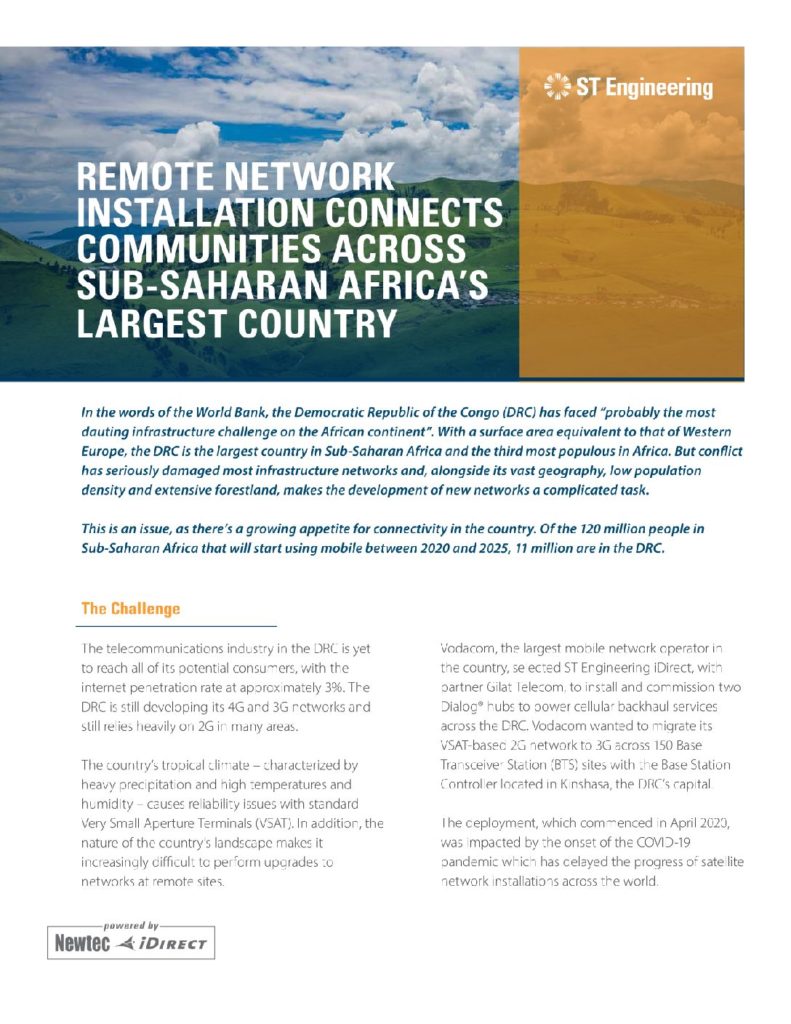
  • Cell Backhaul Overview

    ST Engineering iDirect, a leader in satellite ground infrastructure and solutions for the cell backhaul and trunking market, helps mobile network operators grow their subscribers in previously unreachable areas, maintain mobile connectivity in emergency situations, and build 5G-compatible and hybrid networks that combine satellite and wireless connectivity for multiservice operations.

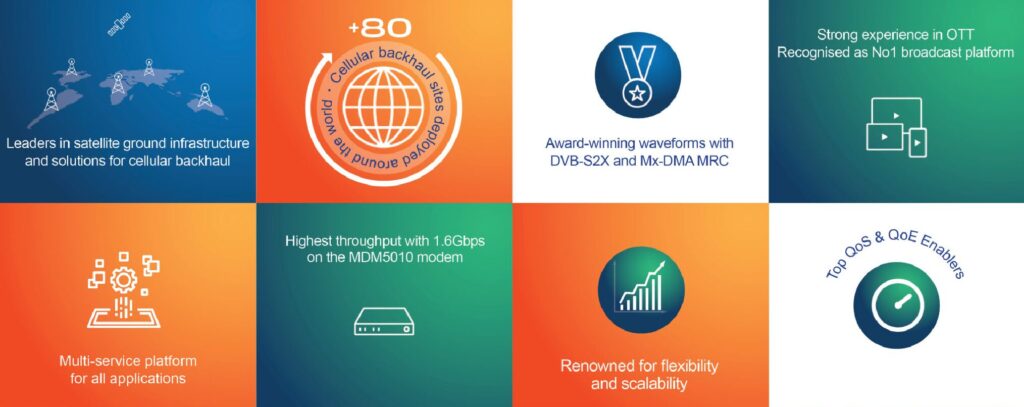
    Today, ST Engineering iDirect is one of the top three modem vendors in the satellite backhaul market, having deployed 80+ mobile backhaul networks. We hold the largest network, with 1500 cellular sites. Twelve of the top 25 telcos are ST Engineering iDirect customers.

    Our efficient, high-performance platform enables mobile network operators and service providers to cost-effectively manage a multitude of small, medium, or large networks, including 3G, 4G/LTE, 5G NSA and 5G SA. We enable a high-quality end-user experience through advanced acceleration and compression technologies while maximizing an operator’s business profitability, encouraging the critical expansion of mobile connectivity around the world.

  • Cell Backhaul Applications

    To keep pace with growing demand and handle the massive amount of traffic coming their way, mobile network operators must look outside of their own networks. This is where satellite connectivity’s inherent capabilities, strengthened by recent innovations, can help mobile operators address key challenges posed by growing demand.

    Mobile Network Expansion

    Considering that a large number of people remain unconnected, an incredible amount of room for mobile demand to multiply from 4G to 5G and feed the growth of traditional backhaul. These growth projections stem from advances in ground segment satellite technology and lower-cost access networks.

    Traffic Offload 

    Satellite connectivity can help relieve congestion in densely-populated urban areas where demand during peak hours is too high for terrestrial networks alone.

    Critical Connectivity

    With satellite connectivity, mobile operators can offer first responders and government agencies critical communications immediately following a disaster for first response efforts, ensuring relief teams can connect residents, coordinate aid, and maintain the continuity of government as communities recover.

    Improving Resiliency

    Satellite is the ideal solution to provide backbone connectivity to regions that have no access to a fiber or undersea cable infrastructure, or when the backbone link needs to cross regions that cannot be secured. It is also the fastest method to re-establish the connection and ensure continued mobile coverage in the area.

    IP Trunking 

    Satellite trunking networks provide local and mobile networks with access to the Internet backbone or to the mobile core. Providing IP trunking and backbone services to ISPs and telecom operators requires constant scrutinizing of the operational expenses due to a highly competitive market with razor thin margins.

  • Cell Backhaul Key Features

    Bandwidth Efficiencies

    Satellite networks have made significant gains in performance and efficiency the use of the latest DVB-S2X standard and our Mx-DMA MRC multiple-access waveform that combines the best features of SCPC and MF-TDMA technologies. It offers SCPC-like efficiency and performance with TDMA-like scalability, allowing service providers to share satellite capacity efficiently across a wide range of applications. This dynamic return technology ensures seamless bandwidth allocation in real time, enabling service providers to handle complex traffic demands effortlessly and provides the highest quality of experience (QoE) on a multi-service platform. With Mx-DMA MRC, service providers can achieve superior network performance and service agility, supporting everything from bursty traffic to high-bitrate services, whether fixed or mobile.

    Superior Quality of Service

    Our bandwidth-allocation algorithm also allows for countless possibilities of Quality of Service levels, bandwidth management, and traffic prioritization. Mobile network operators can map their core networks to satellite networks to prioritize traffic and maintain distinct Quality of Service settings by remotes, bandwidth groups, and applications to satisfy Service Level Agreements.

    Traffic Optimization 

    ST Engineering iDirect has developed the latest standards and techniques in acceleration and compression to achieve maximum throughput and efficiencies. By using compression, packet coalescing and GTP acceleration our system optimally handles multi-service traffic while ensuring network security with end-to-end IPSec optimization. Traffic optimization and compression is built into the Dialog platform to enhance bandwidth optimization for voice and data, while at the same time accelerating the traffic.

    Security

    A standard LTE implementation will use IPsec to secure all communications by authenticating and encrypting the data from the LTE eNodeB or gNodeB through the network to the Security Gateway within the Mobile Network Operators Core Network.

    Trunking

    Solutions for high-speed trunking are leveraging DVB-S2, DVB-S2X and S2 Extensions. iDirect’s MDM6000 combines a set of innovative technologies which help provide exceptional service quality at the lowest possible cost. The MDM6000 can be deployed in single SCPC links, but also in a hub-and star network.