By Shravan K Gaddam, VP Engineering, CTO Office, ST Engineering iDirect
The conversation around 5G non-terrestrial networks (NTN) has moved beyond vision and into execution.
Across the telecom ecosystem, operators, satellite providers and technology partners now agree on the destination: seamless, ubiquitous connectivity delivered through integrated terrestrial and satellite networks. What remains under discussion is the fastest and most practical path to get there. Increasingly, the answer is clear.
Hybrid network architectures, combining existing satcom infrastructure with 5G-ready, standards-aligned platforms, are emerging as the most effective way to accelerate NTN deployments while protecting current investments.
Recent research by ST Engineering iDirect, alongside ongoing collaboration with partners like Capgemini on 5G NTN integration, confirms that hybrid architectures are not only technically viable, but they are also the model operators trusted most to deliver scalable 5G NTN services.
From standalone systems to hybrid architectures
Satellite and terrestrial networks have traditionally evolved as separate environments, each with their own core, authentication and management systems and its corresponding operational processes. While this separation enabled innovation within each domain, it also created complexity when trying to deliver unified services across both. 5G NTN changes the requirements.
To support provider roaming, mobility, service continuity and enterprise-grade performance, satellite networks must integrate directly with 5G cores just like terrestrial networks have and operate as part of a common architecture.
A hybrid model makes this possible without requiring operators to replace existing satcom platforms. In a hybrid architecture, existing multi-orbit satellite networks continue to operate, while standards-based interfaces enable integration with the 5G core. Network functions can evolve toward virtualized and cloud-native deployments, and terrestrial and satellite resources can be orchestrated through a unified management layer.
There are two ways of achieving this:
One is for satellite operators who want to use their existing (non-3GPP) satcom infrastructure to access the 5G Network. ST Engineering iDirect has already demonstrated at WSBW that with its newly developed Satellite Interworking Gateway (SIG) based on 3GPP standards that acts as an intermediary between non-3GPP networks and 5G Networks via AGF. This allows satellite operators to tap into 5G Core efficiencies while continuing to use their current satellite waveforms—protecting existing investments and enabling new non-3GPP inter-provider roaming and revenue opportunities without major infrastructure changes.
The other one is for telco and satellite operators, using native 5G NR NTN architecture including satellite optimized gNodeB and 3GPP’s 5G NR (New Radio) waveform to connect 5G UEs to the 5G Network. This is the model telcos prefer because it aligns directly with their standards-based RAN architecture, simplifies roaming, and extends terrestrial coverage seamlessly via satellite.
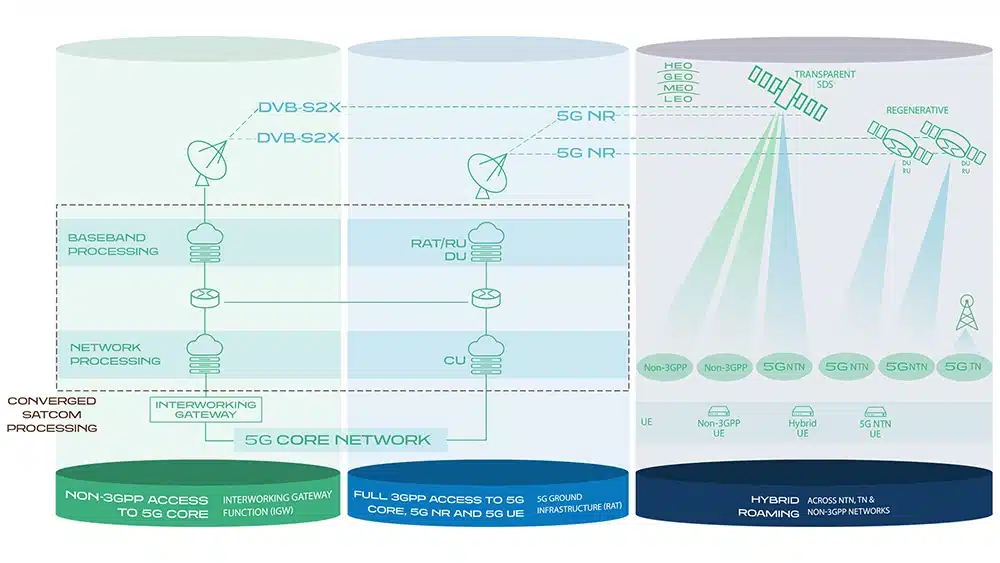
This hybrid approach provides options for a controlled, low-risk migration path from today’s satcom environments to full 5G NTN capability.
Industry collaboration accelerating NTN readiness
The move toward hybrid architecture reflects a broader industry effort to align infrastructure, standards and operational models. ST Engineering iDirect is working across the ecosystem to enable this transition, including a collaboration with multiple partners for different layers in the stack and components in the solution to advance 5G NTN solutions that integrate satellite and terrestrial networks into a unified architecture.
This work focuses on validating real-world deployment models, accelerating standards-based integration and helping operators adopt NTN without disrupting existing services. As the industry moves toward converged networks, collaboration between satellite technology providers, mobile operators and system integrators is becoming essential to turning 5G NTN from concept into commercial reality.
What survey data tells us about market readiness
To better understand how operators are planning for this transition, ST Engineering iDirect commissioned a global survey of 350 telecom decision-makers across seven markets, including mobile network operators, infrastructure providers and cloud service companies.
The findings show strong momentum behind satellite integration and 5G NTN adoption. Almost all respondents see satcom as strategically important, with 95% describing it as essential or important to achieving seamless global connectivity, and 93% expecting satellite to play a bigger role in their business going forward. Investment is also increasing, with 88% planning to grow spending on satellite technologies over the next five years.
The survey also shows that expanding coverage remains a top priority, with 22% naming 5G expansion as their biggest technology focus in the next 12 months, while 19% already see 5G NTN as a future growth opportunity. These results confirm that the market is ready to move forward, but only with architectures that allow integration without disruption.
Barriers to adoption remain real
Deploying 5G NTN is not just a technology challenge. Operators must manage costs, integrate with existing infrastructure and ensure interoperability across multiple vendors and network domains. In many cases, current satcom platforms, terrestrial cores and management systems were never designed to work together as a single environment.
Replacing them entirely is not realistic. Hybrid architecture allows operators to overcome these barriers by integrating satellite networks with 5G cores using standards-based interfaces while continuing to use proven infrastructure. This reduces risk, shortens deployment timelines and allows organizations to evolve their networks at their own pace.
Integration concerns are shaping architectural decisions
As operators plan their future networks, integration risk is becoming one of the most important factors in technology selection. Solutions must support 3GPP-aligned NTN standards, interoperate with existing satcom ground systems and enable migration toward virtualized and cloud-native deployments. They must also support orchestration across terrestrial and multi-orbit satellite networks.
Hybrid architectures address these requirements by allowing new capabilities to be introduced incrementally, creating a converged environment where satellite and terrestrial connectivity can be managed as part of a single network rather than separate systems.
Technology priorities for the next phase of NTN
Across the industry, several priorities are shaping the roadmap to 5G NTN. Standards alignment is critical for interoperability and long-term scalability, while cloud-native and software-defined platforms enable more flexible deployment and simpler upgrades. Intelligent orchestration is also becoming essential for managing hybrid networks across multiple orbits and access technologies.
Conclusion
Demand for global, resilient and high-performance connectivity continues to grow, and terrestrial networks alone cannot meet that demand. 5G NTN will play a key role in extending coverage and enabling new services, but adoption depends on how easily satellite can be integrated into existing environments.
Hybrid architectures provide the fastest path forward, allowing operators to align with evolving standards and scale at their own pace.
The future of connectivity will not be terrestrial or satellite alone, but hybrid networks that combine both into a single, orchestrated system.
Listen to our on-demand webinar on how hybrid architectures are enabling scalable 5G NTN deployments, discover how operators are overcoming integration challenges, accelerating deployment timelines and building the foundation for the next generation of global connectivity.