By Brian Jakins, SVP Global Sales, ST Engineering iDirect
At this year’s Mobile World Congress, one theme that stood out above the rest: non-terrestrial networks (NTN) are no longer a future concept. They are entering a phase of real-world validation.
For years, the industry has talked about the potential of 5G NTN to extend coverage, improve resilience and unlock new services. What MWC2026 demonstrated is that the conversation has shifted. The focus is no longer on if NTN will play a role in 5G, but on how quickly it can be deployed at scale.
From concept to deployment
The progression mirrors what we have seen before in terrestrial networks. Early innovation creates momentum, but it is standardization, ecosystem alignment and architectural maturity that drive adoption.
That shift is now underway in satcom.
The industry is moving beyond isolated proofs of concept toward integrated, standards-based deployments. The emergence of 3GPP-aligned architectures, combined with increasing collaboration between mobile network operators and satellite providers, is laying the foundation for scalable 5G NTN services.
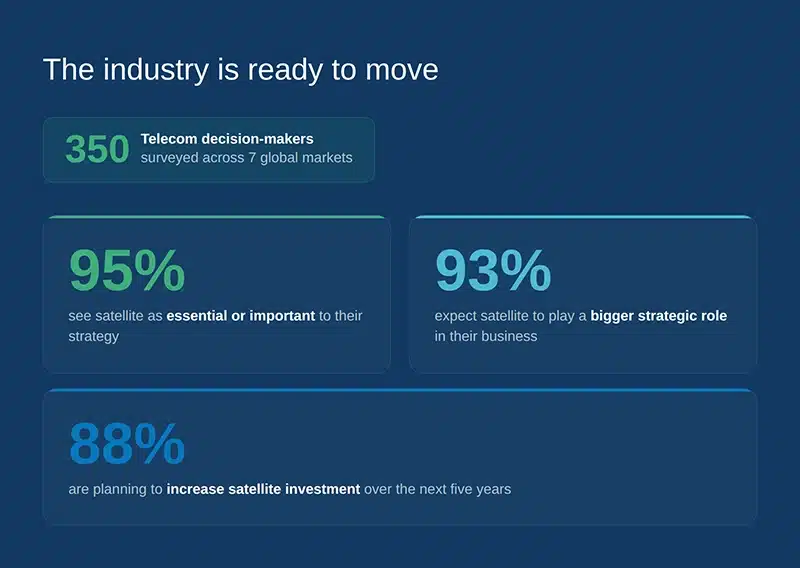
This evolution is critical. In our recent global industry survey of 350 telecom decision-makers across seven markets, 93% said they expect satellite to play a bigger strategic role in their business, while 88% are planning to increase investment over the next five years. The demand is already there. What has been missing is the operational framework to support it at scale.
MWC2026 made it clear that this framework is now taking shape.
Key takeaways from MWC2026
Several themes emerged consistently across the event.
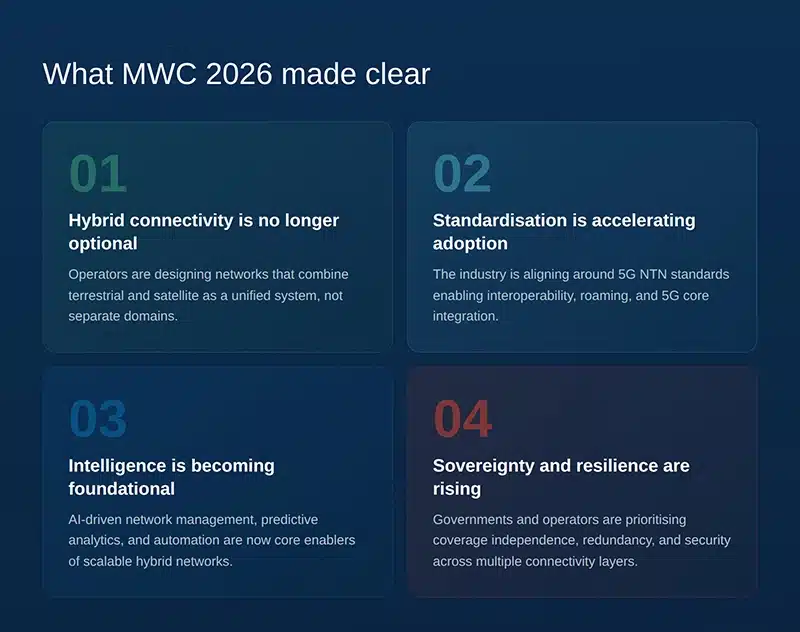
First, hybrid connectivity is no longer optional. Operators are increasingly designing networks that combine terrestrial and satellite capabilities as a unified system, rather than treating them as separate domains.
Second, standardization is accelerating adoption. The industry is aligning around 5G NTN standards that enable interoperability, roaming and integration with existing 5G cores. This is essential to achieving the seamless user experience that enterprises and users now expect.
Third, intelligence is becoming foundational. AI-driven network management, predictive analytics and automation are no longer experimental capabilities. They are being positioned as core enablers of scalable hybrid networks.
Finally, sovereignty and resilience are rising up the agenda. Governments and operators alike are prioritizing network architectures that provide coverage independence, redundancy and security across multiple layers of connectivity.
Taken together, these signals indicate a market moving from exploration to execution.
What the data tells us about market readiness, timelines and investment
While MWC showcased the momentum, our global survey provides a clearer picture of market readiness, deployment timelines and investment priorities.
The appetite is undeniable with 95% of executives seeing satellite as either essential or important to their strategy. This is clear evidence that the market is ready to move beyond experimentation.
Deployment timelines are also accelerating. While still emerging, a fifth (19%) of respondents already identify 5G NTN as a future growth opportunity, an indicator of how quickly the market is moving from evaluation to adoption. And 22% of respondents identified expanding 5G coverage as their top priority for the next 12 months, with 5G NTN increasingly seen as a key enabler of that expansion.
At the same time, investment priorities are aligning behind this shift. Nine out of ten (88%) organizations are increasing investment in satellite, while AI (72%), cloud (45%) and IoT (36%) remain key focus areas, all of which are increasingly enabled by scalable, ubiquitous connectivity.
However, the data also highlights a gap between ambition and execution.
Cost (52%), complexity (49%), and regulatory challenges (46%) remain the primary barriers to adoption. These are not new challenges, but they underscore the importance of architectures that simplify integration and reduce time-to-value.
The architectural shift enabling scale
If MWC2026 confirmed anything, it is that technology alone is not enough. Architecture is what will determine how quickly 5G NTN scales.
Today’s satcom environments are still fragmented, with multiple platforms, vendors and management systems operating in silos. This fragmentation slows innovation and limits interoperability.
The industry is now converging on a different model. A cloud-native, 3GPP standards-aligned architecture provides a path to unify these environments, enabling operators to integrate satellite into their 5G core, evolve at their own pace, and protect existing investments.
As highlighted in recent industry discussions and a theme we will expand on in our upcoming keynote at Satellite 2026, the future of connectivity will be defined by hybrid networks that behave as one, combining terrestrial and multi-orbit satellite capabilities into a single, orchestrated system.
This is the bridge from legacy satcom to full 5G NTN participation.
Aligning with the next phase of NTN
At ST Engineering iDirect, our focus has been on enabling this transition.
Built on ST Engineering iDirect’s earlier work in enabling roaming across non-3GPP networks while maximizing the value of their existing infrastructure we are now highlights the second pillar of our 5G NTN roadmap: full 3GPP NTN access integrating ST Engineering iDirect’s satellite-optimized RAN technology, including a 5G gNodeB stack developed as part of the Intuition system.
This approach reflects what the market is asking for:
- interoperability through standards
- scalability through cloud-native design
- intelligence through AI-driven orchestration
It is not about replacing existing infrastructure. It is about evolving it. And that is precisely the model that will enable operators to move from pilot projects to commercial deployment.
A new phase for 5G NTN
MWC2026 did not introduce the idea of 5G NTN. It confirmed that the industry is ready to act.
The combination of market demand, investment momentum and architectural maturity is creating the conditions for large-scale deployment.
The next phase will be defined by execution and by how quickly operators can integrate, scale and monetize hybrid networks. Those that move early will not just extend coverage. They will redefine what connectivity looks like.
Join us at Satellite 2026
To learn more about how ST Engineering iDirect is enabling the transition to 5G NTN, book a demo with our team at Satellite 2026.
And don’t miss CEO Don Claussen’s keynote:
“The Relentless Pursuit of Ubiquitous Connectivity through 5G NTN Networks” March 25, 2026 | 11:45 AM | Room 145 A/B