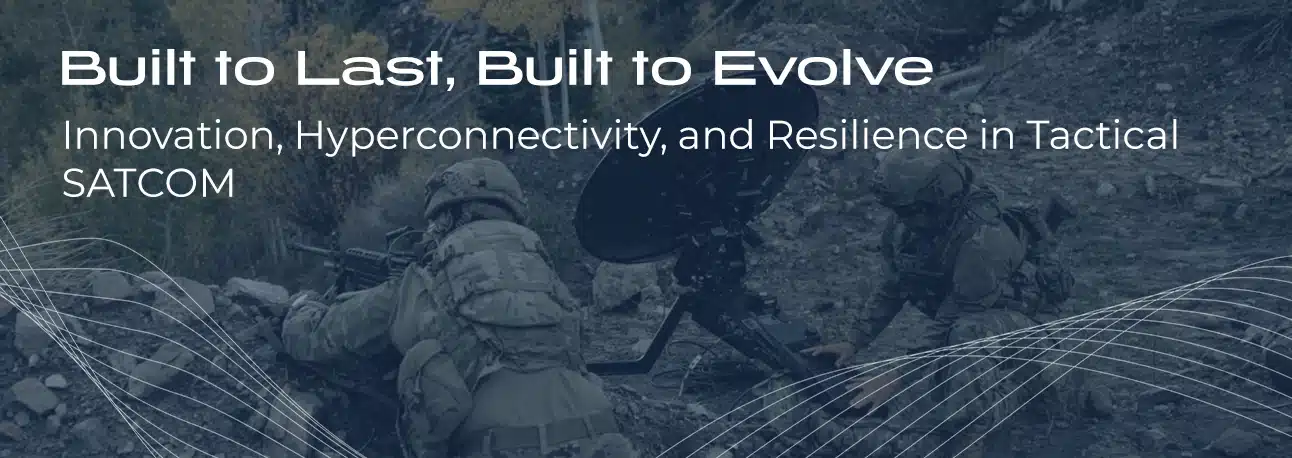
Innovation, Hyperconnectivity, and Resilience in Tactical SATCOM
This Q&A brings together Marconi Technologies and partner perspectives to explore how the Hunter family of tactical SATCOM terminals is evolving to support modern military operations in an era defined by hyperconnectivity, contested communications environments, and multi-domain operations.
As defence forces increasingly rely on distributed sensors, autonomous systems, edge computing, and real-time command-and-control, resilient communications are becoming mission critical. From Arctic deployments to desert operations, the Hunter family is designed to provide adaptable, survivable, and high-capacity connectivity that supports both today’s GEO-based architectures and tomorrow’s multi-orbit networks.
Contributors

Keith Blanchet
VP International Government & Defense, ST Engineering iDirect
Keith Blanchet leads government relations, strategic initiatives, and business development efforts in the international government and defence sectors at ST Engineering iDirect.

Henry Nelson
President – UK, Marconi Technologies
Henry Nelson leads Marconi Technologies’ business in the UK covering its portfolio of Tactical Communications products alongside C2 software solutions and is responsible for the continued development and global strategy of the Hunter family of tactical SATCOM terminals.
Keith:
The industry is placing a lot of emphasis on multi-orbit connectivity and communications resilience. How is Marconi approaching that shift?
Henry:
The shift toward multi-orbit communications is one of the most significant developments we have seen in military SATCOM.
From Marconi’s perspective, the Hunter family provides the rugged, deployable terminal infrastructure that allows operators to access communications services in demanding operational environments. However, resilient multi-orbit networking requires more than antenna technology alone. It also depends on advanced modem technologies, intelligent network management, and the ability to operate seamlessly across multiple satellite constellations and waveforms.
This is where our partnership with ST Engineering iDirect becomes particularly valuable. Hunter terminals are designed to integrate with leading modem platforms that provide access to GEO, MEO, and emerging LEO architectures while supporting government and commercial satellite networks. iDirect’s capabilities in multi-orbit networking, dynamic bandwidth allocation, virtualization, and network orchestration help ensure that the terminal becomes part of a broader resilient communications architecture rather than a standalone asset.
Marconi’s terminal solution, powered by iDirect’s modem technology, builds communications infrastructures that combine rugged tactical access with intelligent network management, allowing operators to maintain connectivity even as mission requirements, satellite resources, or threat conditions change.
Keith:
“Adaptability” is a term that gets used frequently across the industry. What does it mean in practical terms for Hunter?
Henry:
At its core, Hunter is about operational reliability delivering the capability users need.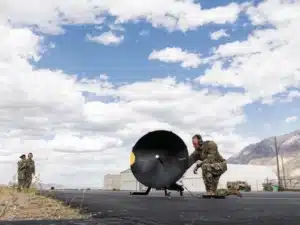
The design philosophy has always been straightforward: operators should be focused on the mission, not troubleshooting communications equipment in the field. Whether it’s the sub-25-pound ULV manpack or the larger FA-370 platform, the goal is rapid deployment, resilient connectivity, and long-term survivability in difficult environments.
The Hunter family was developed around the idea that modern military operations require communications systems that can adapt quickly to changing mission requirements. Today’s battlefield is becoming increasingly hyperconnected, with tactical radios, sensors, autonomous platforms, edge devices, and SATCOM all expected to operate as part of a unified network.
That means SATCOM terminals can no longer operate in isolation. They need to integrate into a broader transport architecture that combines radios, mesh networking, multi-orbit satellite connectivity, and increasingly resilient beyond-line-of-sight communications.
From a practical perspective, Hunter supports quad-band operation across X, C, Ku, and Ka bands, while maintaining compatibility with networks including WGS, SkyNet, Inmarsat GX, SES Flex, and GovSat. Carbon fibre construction helps reduce weight while maintaining structural stability across extreme environmental conditions.
Most importantly, the systems have been proven operationally in demanding environments where reliability matters.
Keith:
You mentioned contested environments and resilience. How important is that becoming for defence customers?
Henry:
Resilience has always been a defining requirement for military communications.
As communication systems have evolved so has the challenge of ensuring they remain resilient. Recent conflicts have demonstrated that communications systems must continue operating despite jamming, interference, cyber threats, spectrum congestion, or the loss of individual network elements. No single technology provides the complete answer.
Marconi contributes by providing highly reliable tactical communications platforms capable of operating in challenging environments and supporting multiple transport paths. At the same time, iDirect contributes sophisticated networking capabilities that enable traffic prioritization, network reconfiguration, multi-path communications, and integration across diverse satellite and terrestrial communications infrastructures.
The result is a layered communications architecture that combines SATCOM, troposcatter, tactical radios, mesh networking, and intelligent network orchestration. This approach provides defence forces with multiple options for maintaining mission-critical communications when parts of the network become degraded or denied.
Increasingly, customers are looking for complete resilient communications ecosystems rather than individual products, and the Marconi-iDirect partnership is well positioned to support that requirement.
Keith:
Marconi Technologies also talks about high levels of customization. How do you balance bespoke requirements against the need for standardized products?
Henry:
The foundation must always be a proven and standardized platform.
The Hunter family provides that foundation through a mature and operationally proven terminal architecture. Customers can deploy quickly while benefiting from established reliability, logistics support, and qualification pedigree.
At the same time, communications networks are becoming increasingly diverse. Different nations and programs often require unique modem integrations, security architectures, sovereign waveforms, network management approaches, or satellite service providers. Through collaboration with partners such as ST Engineering iDirect, Hunter can be integrated into a wide range of communications architectures while maintaining commonality at the platform level.
This balance allows customers to tailor solutions to their operational needs while minimizing development risk and maximizing interoperability with existing and future communications networks.
Keith:
How does Marconi Technologies see the broader communications landscape evolving over the next few years?
Henry:
The future communications environment is being defined by: hyperconnectivity accelerating the adoption of autonomous capabilities, multi-orbit networking, and resilience provided by multiple solutions.
Military organizations increasingly require continuous access to data generated by sensors, autonomous platforms, command-and-control systems, and distributed forces. Supporting these applications requires far more than increased bandwidth; it requires intelligent network architectures capable of managing multiple transport paths and dynamically adapting to changing conditions.
We see a future where tactical terminals such as Hunter serve as resilient access nodes into highly orchestrated communications ecosystems. Through partnerships with technology leaders such as ST Engineering iDirect, these ecosystems can leverage advanced modem technologies, software-defined networking, virtualization, automation, and multi-orbit connectivity to maximize operational effectiveness.
Success will depend on combining trusted field-proven hardware with increasingly intelligent network capabilities. Both elements are necessary to achieve the adaptive and survivable communications architectures that future military operations will require.
Keith:
Finally, for organizations evaluating tactical SATCOM solutions, what is the case for Hunter?
Henry:
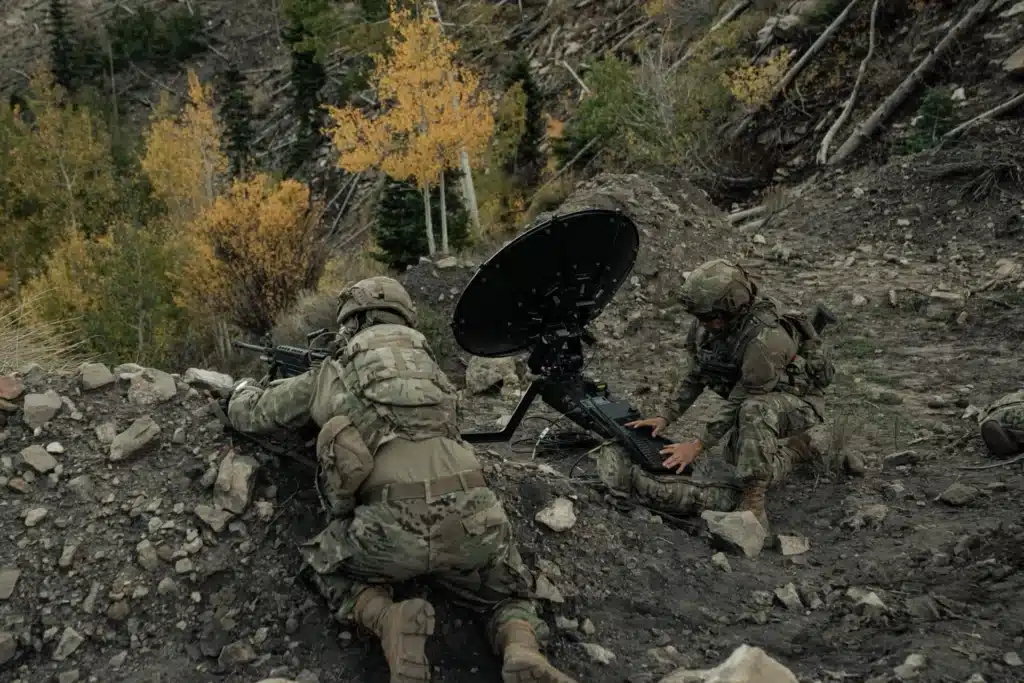
The case for Hunter begins with proven operational performance.
The Hunter family has demonstrated its reliability in some of the world’s most demanding operating environments, providing defence customers with confidence that communications capabilities will be available when needed most.
Equally important, today’s customers are investing not only in terminals but in complete communications architectures. The combination of Marconi’s rugged tactical SATCOM platforms, expertise across the breadth of communication systems including Orion radios and Archer troposcatter systems, and ST Engineering iDirect’s advanced modem, waveform, multi-orbit, and network orchestration technologies provides a powerful foundation for future communications requirements.
The Hunter terminal family, powered by ST Engineering iDirect technology, delivers:
- Proven and rugged tactical SATCOM terminals.
- Access to multiple satellite operators and orbital architectures.
- Advanced modem and waveform capabilities.
- Intelligent network management and orchestration.
- Scalability from small tactical deployments to enterprise-level defence networks.
- A clear evolution path toward future multi-orbit and resilient communications architectures.
Ultimately, customers require communications solutions that can deploy rapidly, adapt continuously, and remain operational under pressure. The combined strengths of Marconi Technologies and ST Engineering iDirect help deliver exactly that outcome.
To find out more about the Marconi Technologies Hunter tactical SATCOM terminal family, visit the Marconi Technologies website or contact the SATCOM business development team.